CHEXX Deposits: Minimums, Coins and Networks
CHEXX deposits are crypto-only. The platform supports 11 crypto assets – USDT, USDC, SOL, ETH, BNB, TRX, GRAM, POL, BTC, LTC and TRUMP – across nine networks. The most common stablecoin minimum is 5 units: USDT is 5 USDT on ERC-20, BEP-20, TRC-20, Polygon and TONCOIN, while USDC is 5 USDC on ERC-20, BEP-20 and Polygon. CHEXX does not charge a fee for receiving deposits and sets no maximum deposit limit. The CHEXX Singapore review also covers withdrawals, bonuses, account access and mobile options.
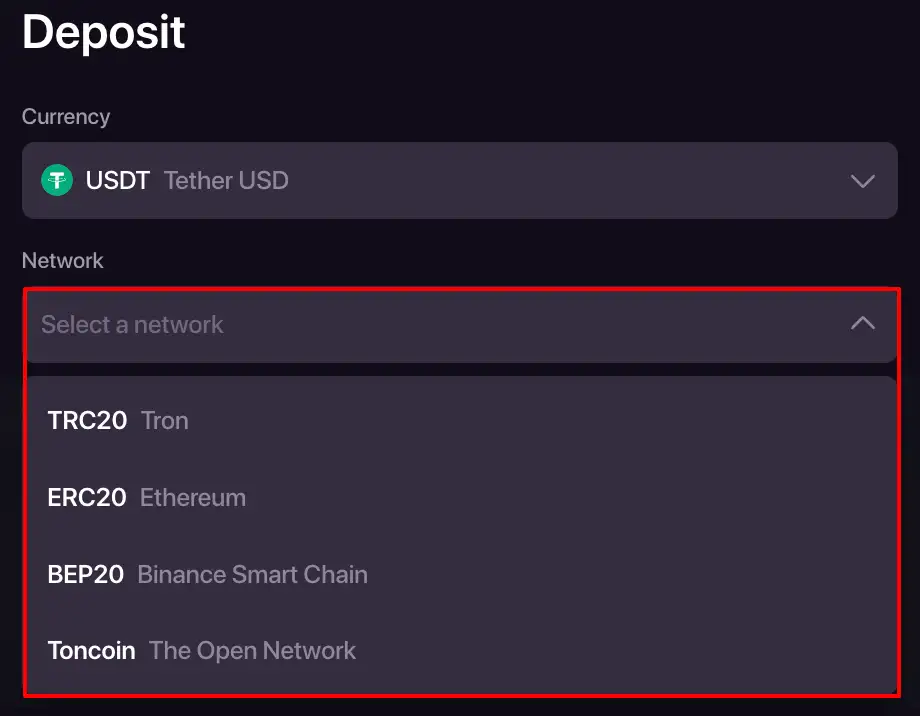
Table of Contents
- CHEXX minimum deposit table
- USDT is available on five networks
- USDC spans ERC-20, BEP-20 and Polygon
- Native-asset minimums
- CHEXX does not charge a deposit receiving fee
- No maximum deposit limit
- Why there is no SGD deposit row
- How the nine-network count is built
- Deposit minima versus promotion thresholds
- Relationship to withdrawals
- Asset-by-asset deposit reference
- Stablecoins account for most multi-network combinations
- Deposit fees, limits and KYC
- CHEXX deposit routes in practice
- Complete asset coverage in the deposit grid
- Native-asset routes
- Stablecoin deposit routes
CHEXX minimum deposit table
| Network | Asset | Minimum deposit |
|---|---|---|
| ERC-20 | USDT | 5 USDT |
| ERC-20 | USDC | 5 USDC |
| ERC-20 | ETH | 0.003 ETH |
| BEP-20 | USDT | 5 USDT |
| BEP-20 | USDC | 5 USDC |
| BEP-20 | BNB | 0.009 BNB |
| TRC-20 | USDT | 5 USDT |
| TRC-20 | TRX | 15 TRX |
| POLYGON | USDT | 5 USDT |
| POLYGON | USDC | 5 USDC |
| POLYGON | POL | 66 POL |
| TONCOIN | USDT | 5 USDT |
| TONCOIN | GRAM | 3.8 GRAM |
| BTC | BTC | 0.00008 BTC |
| SOL | SOL | 0.07 SOL |
| LTC | LTC | 0.12 LTC |
| TRUMP | TRUMP | 3.4 TRUMP |
The grid has to be read as an asset-and-network table rather than as a single site-wide minimum. A stablecoin ticker can appear on several chains, while a native asset has its own route. The minimum follows the exact combination selected.
USDT is available on five networks
USDT has the broadest network coverage in the deposit grid. CHEXX lists it on ERC-20, BEP-20, TRC-20, Polygon and TONCOIN, and the published minimum is 5 USDT on every one of those routes. This means the minimum itself does not distinguish the five USDT choices.
The practical distinction is the network. An ERC-20 USDT deposit and a TRC-20 USDT deposit use the same token ticker but different blockchain rails. A payment reference should therefore name both the asset and network instead of describing every route simply as “USDT”.
That same naming discipline is useful across the rest of the cashier because it prevents two separate questions from being mixed together: which asset is being transferred, and which network carries it.
USDC spans ERC-20, BEP-20 and Polygon
CHEXX lists USDC on three networks: ERC-20, BEP-20 and Polygon. The minimum is 5 USDC for each of the three routes. Like USDT, the stablecoin therefore has multiple rails even though the asset name remains the same.
This multi-network design is one of the reasons the broader CHEXX crypto networks page treats network selection as a first-class payment detail. A list of supported coins without their networks would not fully describe how the cashier is organised.
Native-asset minimums
The grid also includes native-asset routes with different unit scales. ETH is 0.003 ETH on ERC-20, BNB is 0.009 BNB on BEP-20 and TRX is 15 TRX on TRC-20. Polygon’s native POL minimum is 66 POL, while TONCOIN carries a 3.8 GRAM minimum for GRAM.
The standalone network entries are 0.00008 BTC for Bitcoin, 0.07 SOL for Solana, 0.12 LTC for Litecoin and 3.4 TRUMP on the TRUMP route. These values should be kept in their published crypto units. Converting them into a fixed SGD table would introduce exchange-rate values that are not part of CHEXX’s deposit rules.
CHEXX does not charge a deposit receiving fee
CHEXX does not charge a fee for receiving a deposit. Blockchain or third-party transfer costs are separate from the casino’s receiving fee and can depend on the wallet, network and transaction used.
CHEXX’s receiving fee is zero. Wallet, exchange or blockchain charges can exist outside CHEXX and are not included in that platform receiving-fee statement.
No maximum deposit limit
CHEXX sets no maximum deposit limit. Each supported route still has its own minimum.
This distinction is useful when reading a cashier table. A minimum answers the smallest accepted amount for the stated route. It does not imply a corresponding published maximum, and it should not be used to infer one.
Why there is no SGD deposit row
CHEXX’s payment model is crypto-only. The supported list contains crypto assets and blockchain networks rather than Singapore-dollar bank rails, cards or PayNow. For a Singapore reader, SGD is therefore the local comparison currency, not a CHEXX deposit method in this payment model.
SGD is not a CHEXX deposit rail. Crypto minimums such as 0.00008 BTC or 0.003 ETH are fixed asset amounts, while their SGD market values can change.

How the nine-network count is built
| Network group | Assets represented in the grid |
|---|---|
| ERC-20 | USDT, USDC, ETH |
| BEP-20 | USDT, USDC, BNB |
| TRC-20 | USDT, TRX |
| Polygon | USDT, USDC, POL |
| TONCOIN | USDT, GRAM |
| Bitcoin | BTC |
| Solana | SOL |
| Litecoin | LTC |
| TRUMP | TRUMP |
This mapping explains how 11 assets can produce more than 11 deposit combinations. Stablecoins repeat across several networks, while native assets occupy one route. The count of assets and the count of network choices therefore describe different parts of the cashier.
Deposit minima versus promotion thresholds
A cashier minimum and a bonus minimum are different amounts. CHEXX’s welcome bonus uses a $5 qualifying deposit, while weekday promotions can set other thresholds. The asset-network table gives the minimum accepted crypto amount for each deposit route.
A promotion’s qualifying amount is not the same as the cashier minimum for a crypto route. CHEXX bonuses gives the welcome thresholds and reward terms, while the deposit table above gives the transaction minimum for each asset and network.
Relationship to withdrawals
Deposit and withdrawal limits differ even on the same route. BEP-20 USDT has a 5 USDT deposit minimum, while CHEXX gives 3 USDT as the BEP20 USDT withdrawal-minimum example.
CHEXX publishes a 3 USDT minimum example for BEP20 USDT withdrawals, compared with a 5 USDT minimum for BEP-20 USDT deposits. CHEXX withdrawals lists the cashout information, and CHEXX payments covers the wider crypto cashier.
Asset-by-asset deposit reference
| Asset | CHEXX network coverage | Minimum deposit |
|---|---|---|
| USDT | ERC-20, BEP-20, TRC-20, Polygon, TONCOIN | 5 USDT on each route |
| USDC | ERC-20, BEP-20, Polygon | 5 USDC on each route |
| ETH | ERC-20 | 0.003 ETH |
| BNB | BEP-20 | 0.009 BNB |
| TRX | TRC-20 | 15 TRX |
| POL | Polygon | 66 POL |
| GRAM | TONCOIN | 3.8 GRAM |
| BTC | Bitcoin | 0.00008 BTC |
| SOL | Solana | 0.07 SOL |
| LTC | Litecoin | 0.12 LTC |
| TRUMP | TRUMP | 3.4 TRUMP |
This asset view is the inverse of the network table above. It shows why CHEXX describes support in two dimensions. The platform has 11 assets, but USDT and USDC repeat across several rails, so the deposit grid contains 17 asset-network combinations. A simple list of 11 coin tickers therefore understates the number of selectable combinations.
Stablecoins account for most multi-network combinations
USDT contributes five combinations and USDC contributes three. Together they make up eight of the 17 rows in the deposit grid. ETH, BNB, TRX, POL and GRAM then share network families with those stablecoins, while BTC, SOL, LTC and TRUMP have standalone rows.
This structure is a useful way to read CHEXX’s crypto focus. The platform is not merely listing many coin names; it also repeats major stablecoins across several blockchain families. The deposit minimums remain simple for those stablecoins – 5 USDT or 5 USDC on every listed route – while the native assets retain their own unit-specific thresholds.

Deposit fees, limits and KYC
CHEXX supports 11 assets across nine networks, charges no fee for receiving deposits and sets no maximum deposit limit. Route minimums stay denominated in the relevant crypto asset, while any SGD equivalent changes with the market price.
CHEXX ties KYC to suspicious activity rather than to every deposit. All 17 deposit combinations are expressed in their original crypto units.
CHEXX deposit routes in practice
CHEXX uses a detailed crypto deposit grid: 11 supported assets across nine networks, with stablecoins available on several rails and native coins carrying their own minimums. USDT is 5 USDT on each of its five listed networks, USDC is 5 USDC on each of its three, and the native-asset minima range from 0.00008 BTC to 66 POL in their respective units. The table contains 17 asset-network combinations in total, including eight stablecoin rows across USDT and USDC.
CHEXX charges no fee for receiving deposits and sets no maximum deposit limit. For a Singapore reader, the key structural fact is that these are crypto deposit rules, not SGD payment rails.
Complete asset coverage in the deposit grid
The deposit routes include BTC at 0.00008 BTC, SOL at 0.07 SOL, LTC at 0.12 LTC and TRUMP at 3.4 TRUMP. TONCOIN routes include 5 USDT and 3.8 GRAM. Polygon supports 5 USDT, 5 USDC and 66 POL. ERC-20 supports USDT, USDC and ETH, while BEP-20 supports USDT, USDC and BNB.
Native-asset routes
CHEXX also provides standalone deposit routes for Bitcoin, Solana, Litecoin and TRUMP. The minimums are 0.00008 BTC, 0.07 SOL, 0.12 LTC and 3.4 TRUMP. TONCOIN additionally carries a 3.8 GRAM minimum, while Polygon includes 66 POL and BEP-20 includes 0.009 BNB.
Stablecoin deposit routes
USDT has five deposit routes: ERC-20, BEP-20, TRC-20, Polygon and TONCOIN, each with a 5 USDT minimum. USDC has three routes – ERC-20, BEP-20 and Polygon – each with a 5 USDC minimum. These stablecoin combinations account for eight of the 17 asset-network rows.
 StarburstNetEnt
 Sevens HighRoyal Slot Gaming (RSG)
 Book of DeadPlay'n GO
 Love Gems Hold and Win1spin4win
 Astro GemsMaverick
 Trickstar SpinsYggdrasil Gaming
 Sweet BonbonellaSwintt
 Gates of OlympusPragmatic Play
 Epic JourneyRed Tiger Gaming
 Tiger RushThunderkick
 Wild PharaohSwintt
 Hot Hot FruitHabanero
 Sizzling Hot DeluxeNovomatic
 Sugar RushPragmatic Play
 Fuzzy WuzzyPoggiPlay
 Classic BlackjackClassic
 Multihand BlackjackMultihand
 Perfect Pairs BlackjackSide Bet
 Blackjack 21 ClassicClassic
 American BlackjackClassic
 Ultimate Blackjack with RachaelLive-style
 Quantum Blackjack PlusMultiplier
 Premier Blackjack with Side BetsSide Bet
 VIP American BlackjackVIP
 Blackjack Surrender OriginsSurrender
 Atlantic City BlackjackClassic
 European BlackjackMultihand
 Vegas Downtown Blackjack GoldGold Series
 Vegas Strip BlackjackClassic
 Blackjack Lucky LadiesSide Bet
 Quantum RouletteMultiplier
 Monopoly Roulette TycoonThemed
 Lucky RouletteClassic
 Mini Roulette 3DMini
 Roca Riches RouletteThemed
 European RouletteClassic
 Auto RouletteSwitch Studios
 RouletteRelax Gaming
 Multifire RouletteMultiplier
 Gold RouletteGold Series
 Who Wants to Be a Millionaire RouletteThemed
 Mega Fire Blaze RouletteMultiplier
 French RouletteNetEnt
 Double Ball American RouletteDouble Ball
 Immortal Romance RouletteThemed
Prepared by the Chexx Casino editorial staff.