
CHEXX Account and Registration
CHEXX supports four account-entry routes: email, Google, Telegram and WalletConnect. The standard email sign-up asks for an email address and password and includes a currency selection. CHEXX states that KYC is required only if suspicious activity is detected, rather than as a default step for every registration. The CHEXX Singapore review also covers payments, bonuses, games and mobile access.
CHEXX requires users to declare their country. Its restricted list names Belarus, Russia, Ukraine, the United States, Iran, North Korea and Myanmar; Singapore is not on that list. The same country declaration applies whether registration starts with email, Google, Telegram or WalletConnect.
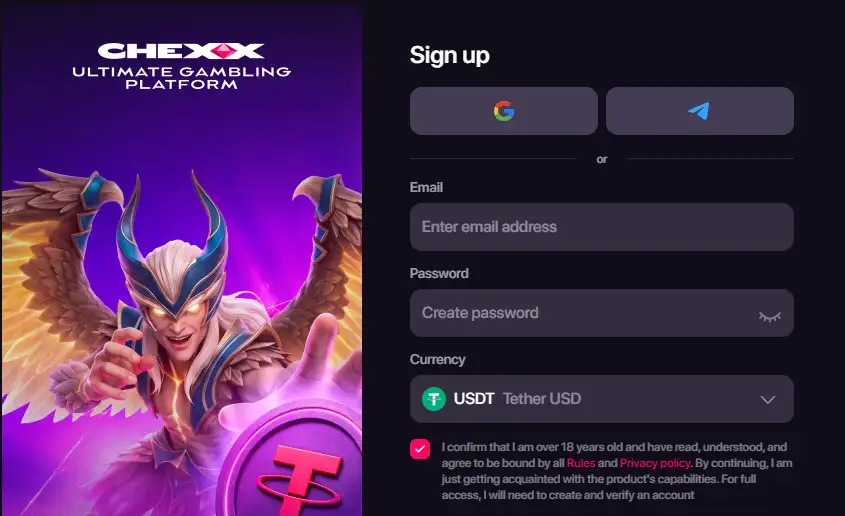
Table of Contents
- CHEXX registration methods compared
- Email registration is the most conventional route
- Google sign-in reduces password handling inside CHEXX
- Telegram registration fits CHEXX’s broader Telegram access model
- WalletConnect is a login route, not a deposit network
- Country declaration should be accurate
- Registration and KYC are separate account stages
- What the profile contains after registration
- Security decisions before the first deposit
- Registration does not change CHEXX’s crypto payment model
- Bonuses come after the account decision
- Singapore regulatory context
- Which registration route is the clearest choice?
CHEXX registration methods compared
| Method | Account starting point | Useful for | What to remember |
|---|---|---|---|
| Email address and password | Users who want a conventional standalone login | Keep the mailbox accessible for security and transaction confirmation | |
| Existing Google account | Users who prefer federated sign-in | Access depends partly on the external Google account | |
| Telegram | Telegram identity | Users already using CHEXX through Telegram features | Protect the Telegram account used for CHEXX access |
| WalletConnect | Compatible crypto wallet connection | Crypto-native users who prefer wallet-linked access | A wallet connection is not the same thing as completing KYC |
The four routes solve the login problem in different ways. They do not create four different casinos or four different payment systems. The account profile remains the central place for wallet, transaction, bonus, security and verification controls.
Email registration is the most conventional route
CHEXX registration presents email as the direct sign-up route and asks for an email address, password and selected currency. It also includes an age-and-rules acknowledgement before the sign-up action. This is the easiest method to understand because it does not depend on another social account or crypto wallet for authentication.
Email is one of four CHEXX registration routes alongside Google, Telegram and WalletConnect. CHEXX states that additional confirmation is not required by default and that KYC becomes required only if suspicious activity is detected.
The currency field is an account display or funding preference. CHEXX’s cashier is crypto-focused and does not list a local SGD banking rail. CHEXX payments gives the supported assets, networks and route-specific deposit minimums.
Google sign-in reduces password handling inside CHEXX
Google registration lets a user start from an existing Google identity rather than creating a separate CHEXX password setup at the first step. This can reduce the number of credentials a person needs to remember, but it also means access to the external Google account becomes part of the login chain.
That trade-off is common with federated sign-in. It can be convenient across devices, especially when a phone or browser is already signed into Google, but users should maintain strong security on the Google account itself. The practical value is speed and credential consolidation rather than a different CHEXX account type.
After sign-up, profile settings remain the place to review linked accounts, security and confirmation-code preferences. Those controls matter more over time than the initial choice of registration button.

Telegram registration fits CHEXX’s broader Telegram access model
Telegram is both a registration route and part of CHEXX’s broader access ecosystem. For users who already use the Telegram Mini App, connecting the account through Telegram can reduce friction between the messaging environment and the betting platform.
The convenience should be balanced with account security. A Telegram-linked CHEXX account is only as convenient as access to the underlying Telegram identity. Users should avoid treating Telegram registration as an anonymous substitute for account controls or verification requirements.
Telegram registration uses a Telegram identity for account entry, while Telegram Mini App is an access interface. CHEXX mobile access also includes browser, PWA, Windows and macOS options.
WalletConnect is a login route, not a deposit network
WalletConnect is designed for users who already manage compatible crypto wallets. It lets a wallet participate in the authentication flow, which fits naturally with CHEXX’s cryptocurrency-focused product. The key distinction is that WalletConnect itself is not one of CHEXX’s deposit blockchain networks.
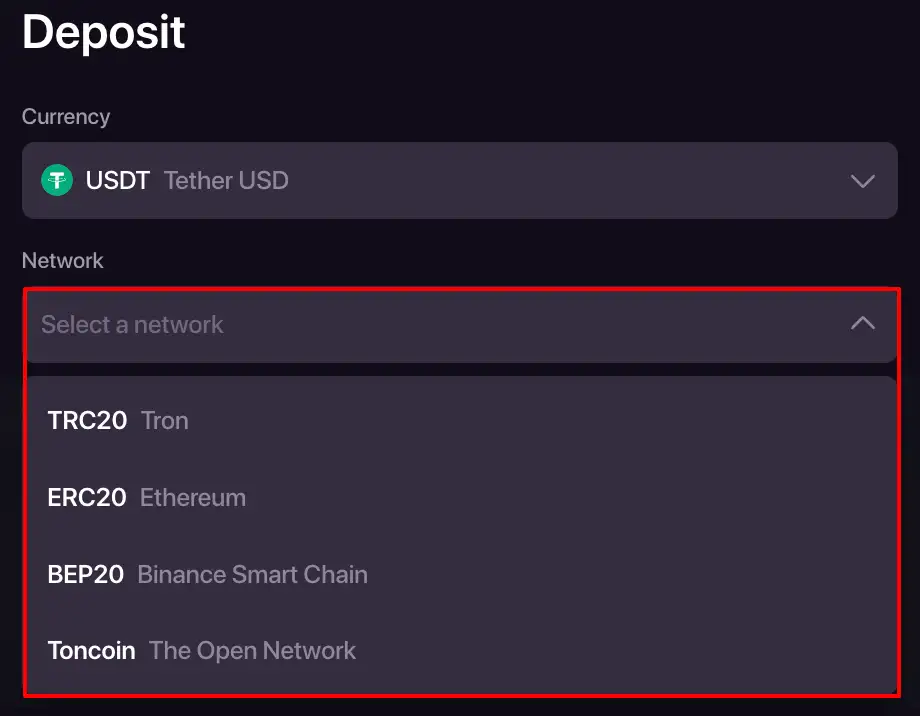
A connected wallet identity and a payment route answer different questions. Registration determines how the user accesses the account. Deposits and withdrawals still require a supported cryptocurrency and matching network. A wallet may support multiple chains, so a successful WalletConnect session does not guarantee that every asset or network in that wallet is supported for payments.
For the payment side, consult the CHEXX crypto networks guide before transferring funds.
Country declaration should be accurate
CHEXX account planning includes a country dimension because gambling access, promotional eligibility and regulatory treatment can differ by jurisdiction. The correct approach is to state the actual country. Registration should never be treated as a reason to misstate location or to bypass a regional control.
CHEXX’s restricted-country list contains seven jurisdictions: Belarus, Russia, Ukraine, the United States, Iran, North Korea and Myanmar. Singapore is not included. Users still need to enter their actual country when opening an account.
After registration, the next practical questions are whether KYC is triggered, which crypto asset will be used for funding and whether a promotion applies. CHEXX states that KYC is required only when suspicious activity is detected.
Registration and KYC are separate account stages
CHEXX maintains a dedicated Verification area in the user profile. That shows that identity verification is an account-control process distinct from the initial choice of email, Google, Telegram or WalletConnect. The sign-up method establishes access; verification deals with identity and compliance checks.
CHEXX requires KYC when suspicious activity is detected rather than as a routine step for every account. It does not set one standard document list or fixed review time for all users. CHEXX KYC gives the country-declaration rule and the suspicious-activity trigger.
The practical lesson is simple: a fast sign-up path does not create a blanket no-KYC guarantee. CHEXX’s stated trigger remains suspicious activity, while additional confirmation is not required by default.
What the profile contains after registration
CHEXX’s Help Center describes the profile as the control centre for Wallet, Transactions, My bets, Bonuses and Verification. It also includes account identity and preference controls such as nickname and avatar, email visibility, linked external accounts, password changes, confirmation-code delivery choices, notifications, interface language and balance-display currency.
This makes the account page more important than the initial registration screen. The sign-up form creates the entry point, while the profile becomes the place where security, communication and transaction history are managed.
Users who register through an external method should pay particular attention to the linked-accounts area. If a login dependency changes later, understanding which external identity is connected can reduce confusion during account recovery.
Security decisions before the first deposit
- Use a registration method you can reliably access later.
- Keep access to the registration method you choose so the account remains recoverable.
- Review linked external accounts in the profile after sign-up.
- Set account and device security before holding a significant balance.
- Confirm the actual cryptocurrency and network you intend to use before depositing.
- Keep country information accurate and do not treat technical access as regulatory approval.
These checks are more valuable than choosing the fastest-looking registration button. Account recovery and payment confirmation happen after sign-up, so the strongest method is the one that remains accessible and understandable over time.
Registration does not change CHEXX’s crypto payment model
No registration route converts CHEXX into a card, PayNow or bank-transfer casino. The account still uses CHEXX’s supported crypto assets and blockchain networks. A Google or Telegram login may feel familiar, but funding follows a different system based on cryptocurrency assets and networks.
That separation is important for Singapore readers because the login interface can look more conventional than the cashier. Before sending funds, users should understand the difference between a display currency, a crypto asset and a blockchain network. The payments guide and its deposit and network pages cover those choices.
Bonuses come after the account decision
Registration can be associated with welcome promotions, but the account method should not be chosen solely around a headline reward. CHEXX bonus terms, promotional mechanics and recurring offers are separate product layers. A user should first establish a secure account and then assess the promotion that applies to the intended deposit or activity.
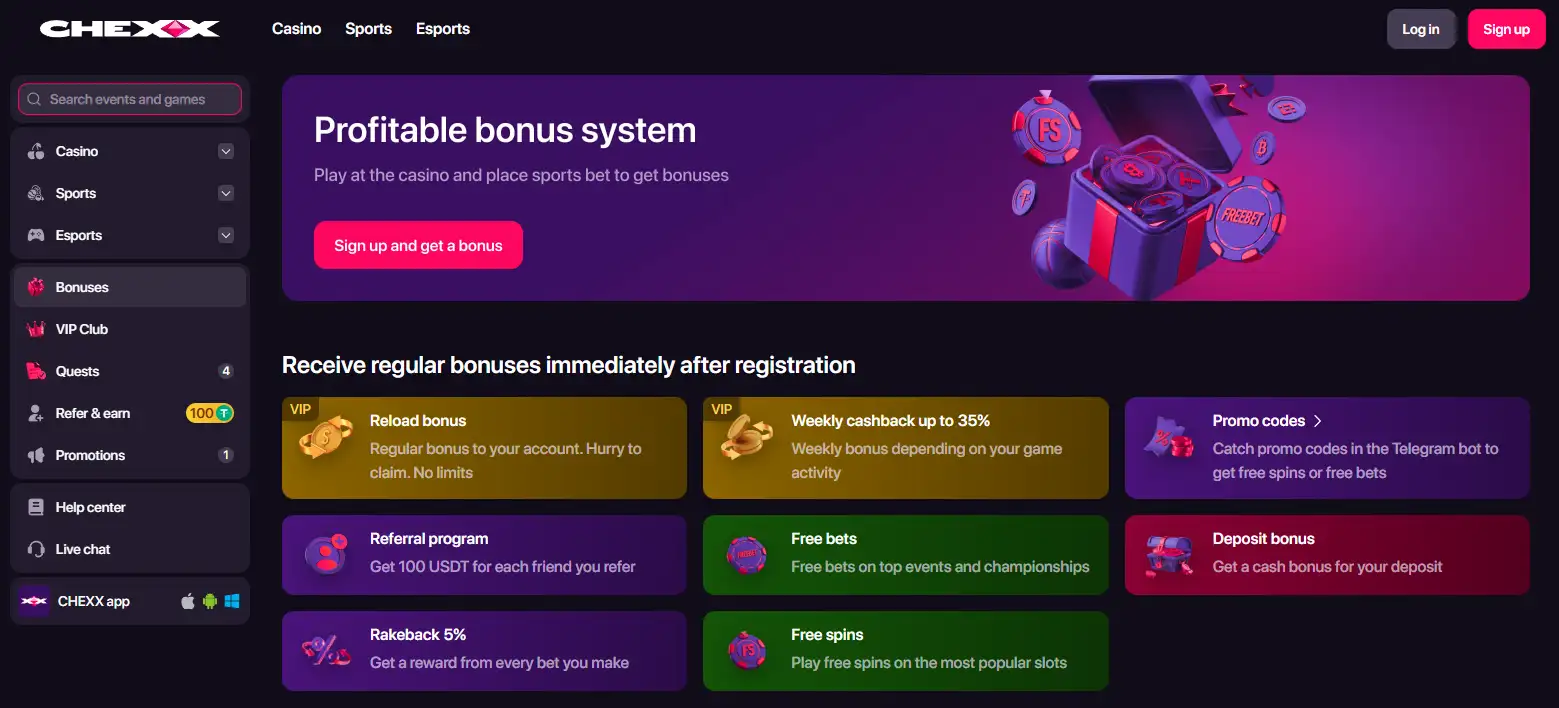
The CHEXX bonuses offer spans the first three deposits, while CHEXX promotions includes rakeback, VIP benefits, quests, referral rewards and the weekly promotion calendar.
Singapore regulatory context
Account creation itself uses the same four entry routes described above. The choice of email, Google, Telegram or WalletConnect does not change CHEXX’s country-declaration requirement or its conditional KYC trigger.
A completed registration gives access to the CHEXX account and cashier. Funding still requires a supported cryptocurrency and matching network, and KYC can become required if suspicious activity is detected.
Which registration route is the clearest choice?
Email is the most straightforward choice for users who want a conventional independent login and direct control of the mailbox used for confirmations. Google can reduce password handling if the user’s Google account is already strongly secured. Telegram is logical for users who want to combine account access with CHEXX’s Telegram environment. WalletConnect is the most crypto-native option for users comfortable managing wallet connections.
None of the four methods removes the need for accurate account details, payment-network matching or possible verification. The best registration route is therefore the one whose recovery and security model the user understands best, not simply the one with the fewest taps.
A sensible test is to ask which credential you could recover confidently after changing phones or losing a browser session. That makes long-term account access part of the registration decision from the start and helps avoid choosing a convenient login that later becomes difficult to recover.
For Singapore remote-gambling rules, see CHEXX licence and Singapore rules.
 Mystic Fortune DeluxeHabanero
 Tiger RushThunderkick
 Hercules Power WildFugaso
 Wanted Dead or a WildHacksaw Gaming
 Gates of OlympusPragmatic Play
 Wong ChoySpadegaming
 Astro GemsMaverick
 Sweet RewardBF Games
 Strength of HerculesHacksaw Gaming
 Sizzling Hot DeluxeNovomatic
 Crazy MummyPascal Gaming
 The Book of AmaterasuMascot Gaming
 Sweet BonanzaPragmatic Play
 Lollipop Drop MultiMaxBulletproof Games
 Single Deck Blackjack GoldSingle Deck
 Quantum Blackjack PlusMultiplier
 Vegas Strip BlackjackClassic
 Blackjack Lucky LadiesSide Bet
 American BlackjackClassic
 Blackjack 21 ClassicClassic
 Blackjack Surrender OriginsSurrender
 European BlackjackMultihand
 Classic BlackjackClassic
 Turbo BlackjackFast-play
 Multihand BlackjackMultihand
 Ultimate Blackjack with RachaelLive-style
 Premier Blackjack with Side BetsSide Bet
 Perfect Pairs BlackjackSide Bet
 Atlantic City BlackjackClassic
 Immortal Romance RouletteThemed
 Dragon RouletteThemed
 RouletteRelax Gaming
 Multifire RouletteMultiplier
 American RouletteClassic
 Quantum RouletteMultiplier
 Auto RouletteSwitch Studios
 French RouletteNetEnt
 Mini Roulette 3DMini
 Who Wants to Be a Millionaire RouletteThemed
 European RouletteClassic
 Monopoly Roulette TycoonThemed
 Gold RouletteGold Series
 Double Ball American RouletteDouble Ball
Prepared by the Chexx Casino editorial staff.