

CHEXX KYC and Account Verification
CHEXX requires KYC only when suspicious activity is detected. A user declares their country in writing, and additional confirmation is not required by default. Verification can still become mandatory if suspicious activity is identified, so CHEXX should not be treated as a blanket “no-KYC” platform. For a broader account overview, see the CHEXX Singapore review.
CHEXX does not use one fixed KYC document checklist, a Level 1/2/3 verification sequence or a standard processing-time promise for every account. The core rule is country declaration by default and KYC when suspicious activity is detected.
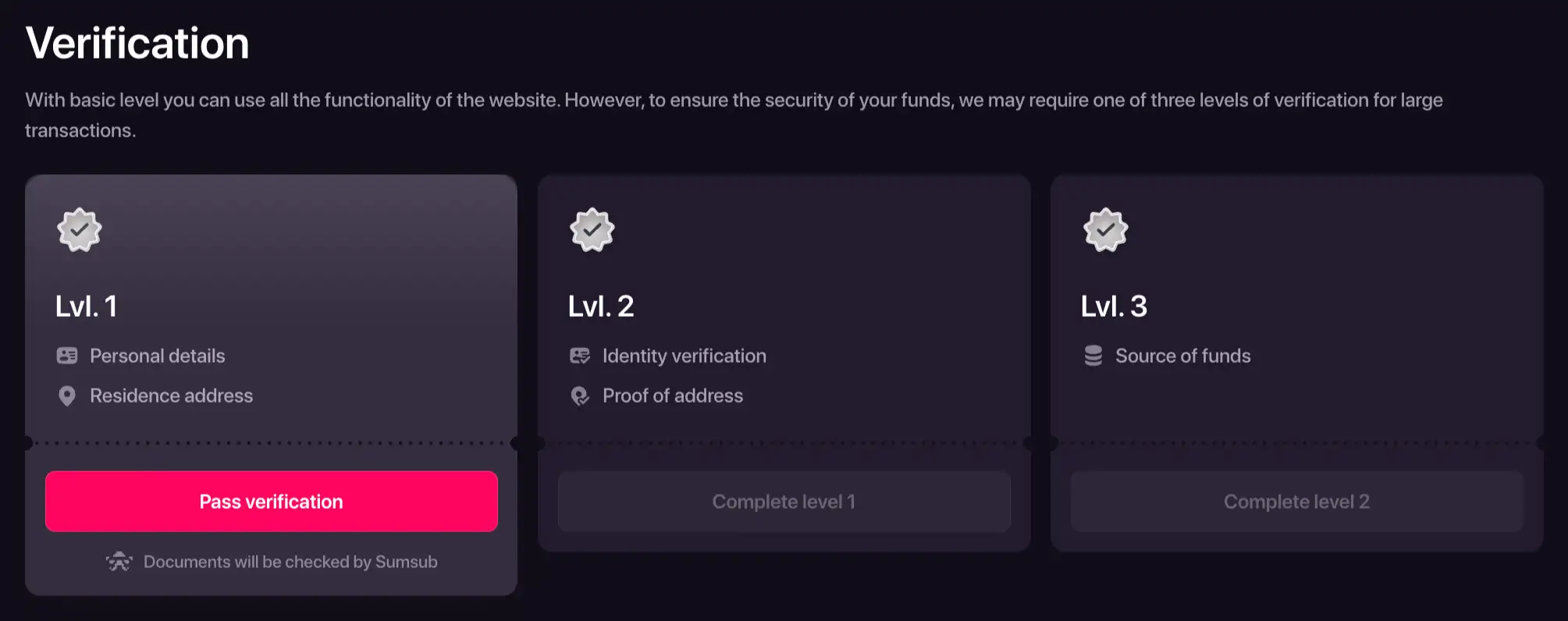
Table of Contents
- When CHEXX requires KYC
- Country declaration and KYC are different account controls
- Why “KYC only on suspicion” is not the same as “no KYC”
- Documents, verification levels and processing time
- How KYC relates to CHEXX withdrawals
- KYC across CHEXX registration methods
- What to expect before opening an account
- What the suspicious-activity trigger does and does not tell you
- CHEXX KYC policy in practice
- Account details connected to the KYC trigger
- Support channels available to CHEXX users
- Country declaration and support languages
- Age and account eligibility
When CHEXX requires KYC
| Question | Account rule | Practical meaning |
|---|---|---|
| Is KYC required for every account by default? | No. CHEXX says it does not require additional confirmation by default. | Routine account creation is not described as an always-on KYC process. |
| What does the user declare? | The user must declare their country in writing. | Country declaration is separate from additional identity verification. |
| When is KYC required? | Only if suspicious activity is detected. | KYC is conditional, not absent. |
| Is there one fixed document list for every account? | No. | CHEXX does not require one standard passport, address-document or source-of-funds checklist for every account. |
| Is there a fixed verification time? | No. | CHEXX does not set a universal five-minute, 24-hour or 72-hour completion promise. |
The suspicious-activity trigger is the key difference between CHEXX’s policy and an always-on verification process. Routine registration is not described as mandatory multi-level KYC, but an account can still be required to complete verification when the stated trigger applies.
Country declaration and KYC are different account controls
Country declaration happens as part of the account relationship, while additional KYC is conditional. Declaring a country does not by itself mean a document-verification process has started.
The distinction also matters when registration methods are considered. CHEXX supports registration through email, Google, Telegram and WalletConnect. Those are account-entry routes, not four different KYC standards. A user can choose a registration route while the conditional KYC rule remains the same. The CHEXX registration options include email, Google, Telegram and WalletConnect.
CHEXX’s restricted-country policy is another separate layer. The brand identifies seven restricted jurisdictions: Belarus, Russia, Ukraine, the United States, Iran, North Korea and Myanmar. Singapore is not in that product-level restricted list. This is CHEXX’s country-acceptance rule; Singapore’s remote-gambling rules still apply independently.
Why “KYC only on suspicion” is not the same as “no KYC”
A blanket no-KYC claim would mean verification is not required. CHEXX does not say that. It says KYC becomes required when suspicious activity is detected. The difference is substantial because a conditional control still exists and can become mandatory for an account that meets the stated trigger.
CHEXX is not verification-free: KYC becomes mandatory when suspicious activity is detected. At the same time, the policy does not describe a standard document check for every account before normal use.

Suspicious activity is the KYC trigger, but CHEXX does not define one universal list of triggering events.
Documents, verification levels and processing time
CHEXX does not set one standard passport, national identity card, driving licence, utility bill, bank statement, selfie or source-of-funds checklist for every account.
CHEXX does not define Level 1, Level 2 or Level 3 KYC stages. Verification is conditional on suspicious activity rather than organised as a fixed ladder for every user.
CHEXX does not set a universal KYC processing time such as five minutes, 24 hours or 72 hours.
How KYC relates to CHEXX withdrawals
CHEXX describes withdrawal service as available for prompt withdrawal 24 hours a day, seven days a week. That service wording does not remove the KYC rule. If suspicious activity is detected, KYC becomes required even though verification is not a default step for every account.
KYC is not an automatic condition of every withdrawal; suspicious activity is the trigger. CHEXX withdrawals gives the 24/7 service wording and the 3 USDT BEP20 minimum example.
Withdrawal service is available 24 hours a day, seven days a week, while route-specific limits depend on the selected cashout method. KYC becomes relevant only when the suspicious-activity trigger applies.
KYC across CHEXX registration methods
Email, Google, Telegram and WalletConnect are CHEXX’s four registration routes. The conditional KYC rule applies to the account regardless of which of those entry methods is used.
Changing the registration method does not create a different verification standard. A Google, Telegram or WalletConnect sign-up follows the same rule: country declaration, no additional confirmation by default and KYC if suspicious activity is detected.

Email/password registration and the Google, Telegram and WalletConnect options all lead into the same account-level KYC rule: verification remains conditional after registration.
What to expect before opening an account
A user declares their country, additional confirmation is not required by default, and KYC becomes required when suspicious activity is detected. There is no universal document list or fixed processing time for every account.
Users should expect that verification can become mandatory when suspicious activity is detected, while routine account creation is not described as a standard three-stage KYC process.
Singapore is not on CHEXX’s seven-country restricted list. The account-verification policy remains the same for users who can register: country declaration by default and KYC when suspicious activity is detected.
What the suspicious-activity trigger does and does not tell you
The suspicious-activity trigger defines when additional KYC becomes required. CHEXX does not provide a universal catalogue of the account signals that can lead to that decision.
| Account rule | What is not fixed for every account |
|---|---|
| Country is declared in writing. | A universal document pack for every account. |
| No additional confirmation is required by default. | A mandatory verification sequence before ordinary use. |
| KYC is required when suspicious activity is detected. | A fixed list of suspicious-activity indicators. |
| Conditional verification remains part of the account model. | A fixed completion time once KYC is triggered. |
Before registration, the key KYC expectation is simple: CHEXX does not require additional confirmation by default, but it can require KYC when suspicious activity is detected. The policy does not specify a standard document list or fixed completion time.
CHEXX KYC policy in practice
CHEXX’s KYC position is unusually specific: additional confirmation is not required by default, the user declares their country in writing, and KYC is required only when suspicious activity is detected. That is a conditional-KYC model, not a no-KYC guarantee and not an always-on verification process.
There is no fixed document checklist, verification-level sequence or processing-time promise for every user. KYC becomes mandatory when suspicious activity is detected.

Account details connected to the KYC trigger
CHEXX lets users register with email, Google, Telegram or WalletConnect. The registration route does not change the KYC trigger. A user declares their country in writing, and CHEXX says no additional confirmation is required by default. If suspicious activity is detected, KYC becomes required for the account.
CHEXX’s restricted-country list contains Belarus, Russia, Ukraine, the United States, Iran, North Korea and Myanmar. Singapore is not on that list. Country declaration is therefore an account detail that CHEXX expects from the user even though routine additional identity confirmation is not described as a default registration step.
Support channels available to CHEXX users
CHEXX lists 24/7 support through live chat, email and Telegram. The support email is [email protected], and the support Telegram bot is @ChexxSupportBot. CHEXX also lists support in English, Spanish and Portuguese through its help-centre language set.
Those channels give account holders several ways to ask about an account request if KYC is triggered. If KYC is triggered, these channels can be used for account support. CHEXX does not set one universal document checklist or fixed processing time for every case.
Country declaration and support languages
CHEXX’s interface languages are English, Spanish and Portuguese, and the same help-centre language set is used for support information. The platform is positioned worldwide outside its seven restricted jurisdictions. Account registration can start with email or with Google, Telegram or WalletConnect, but the user still declares their country. That country declaration is the standard geographic account step described by CHEXX; additional KYC remains conditional on suspicious activity rather than being attached to one language, one registration method or one supported payment asset.
CHEXX is also crypto-only for deposits. Payment choice does not replace the country declaration or change the KYC trigger. The account policy and the cashier therefore use different inputs: country information for the account, and supported crypto assets and networks for funding.
Age and account eligibility
CHEXX sets a minimum age of 21+. Age eligibility and country declaration apply independently of the suspicious-activity KYC trigger: being old enough to register does not remove the requirement to declare the actual country, and a routine account can still be asked to complete KYC if suspicious activity is detected. CHEXX accepts users worldwide outside Belarus, Russia, Ukraine, the United States, Iran, North Korea and Myanmar. Singapore is not on that seven-country restricted list.
For Singapore remote-gambling rules, see CHEXX licence and Singapore rules.
 Sevens HighRoyal Slot Gaming (RSG)
 Wanted Dead or a WildHacksaw Gaming
 Book of the SunPascal Gaming
 Sweet BonanzaPragmatic Play
 Gates of OlympusPragmatic Play
 The Book of AmaterasuMascot Gaming
 Trojan KingdomJust For The Win
 Love Gems Hold and Win1spin4win
 Beef Up the Bonus Power ComboHigh Limit Studio
 Money Train 3Relax Gaming
 Wild FudgeBetixon
 GemonexBetixon
 CleopatraIGT
 Classic BlackjackClassic
 VIP American BlackjackVIP
 Atlantic City BlackjackClassic
 Vegas Strip BlackjackClassic
 Premier Blackjack with Side BetsSide Bet
 Ultimate Blackjack with RachaelLive-style
 Blackjack Lucky LadiesSide Bet
 Quantum Blackjack PlusMultiplier
 American BlackjackClassic
 Single Deck Blackjack GoldSingle Deck
 Turbo BlackjackFast-play
 European BlackjackMultihand
 Multihand BlackjackMultihand
 Blackjack Surrender OriginsSurrender
 Perfect Pairs BlackjackSide Bet
 Dragon RouletteThemed
 Multifire RouletteMultiplier
 Gold RouletteGold Series
 Roca Riches RouletteThemed
 Mini Roulette 3DMini
 Mega Fire Blaze RouletteMultiplier
 RouletteRelax Gaming
 Immortal Romance RouletteThemed
 Double Ball American RouletteDouble Ball
 Lucky RouletteClassic
 Auto RouletteSwitch Studios
 European RouletteClassic
 French RouletteNetEnt
 Who Wants to Be a Millionaire RouletteThemed
Published by the Chexx Casino team.